Eva Mandl
The Glass RoomEva Mandl is introduced as the beautiful, watchful young wife of the Viennese arms dealer Fritz Mandl, but she is more than an object of admiration: her former film career, constrained marriage, and escape with Hana reveal how public attention and private power can leave a woman exposed rather than free.
Identity and Introduction
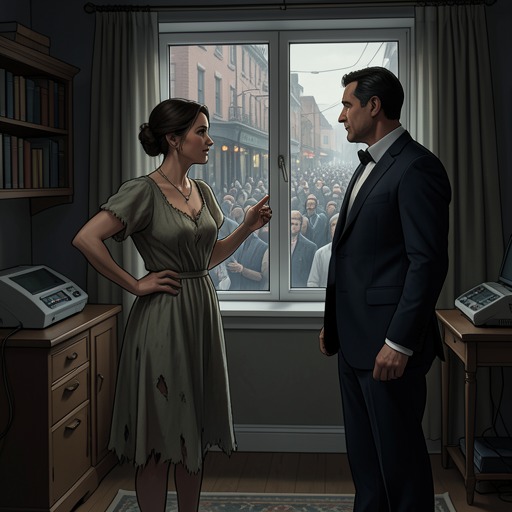
Eva arrives at the Landauer House with her husband, whose Hirtenberger Patronen-Fabrik is discussing a possible joint venture with Viktor’s company. The business conversation concerns the growing military-equipment market, including armoured cars; the narrative’s attention, however, turns to Eva. She appears young, with dark shoulder-length hair and grey-green eyes, and her expression seems poised between smiling and crying. When she praises the modern house, she and Viktor find common ground in their interest in modern things.
Hana recognizes Eva from Gustav Machatý’s film Extase and exclaims that she is Hedy Kiesler. Eva answers quietly that she acted when she was very young and has left films behind. The recognition brings her former screen image into a room where she appears anxious beside her husband. Hana treats the public display of Eva’s body in the film as a matter of artistic change, while the couple’s embarrassment makes clear that the same exposure carries a different weight for them.
Marriage and Vulnerability
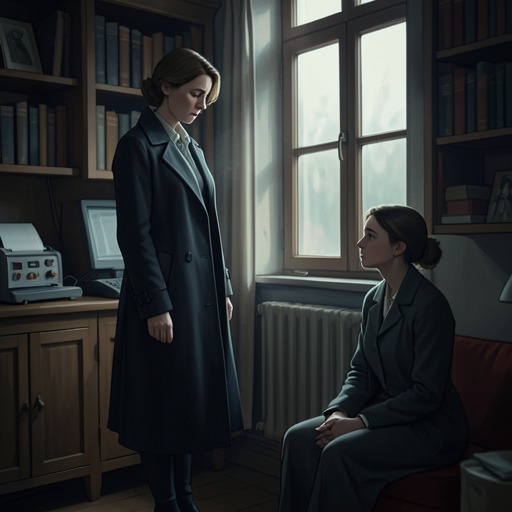
Eva’s marriage to Fritz Mandl places her beside a powerful businessman, but the story presents her as subject to his arrangements rather than secure within them. When Hana describes the escape, Eva has been accompanied by a woman she calls a walrus; Hana says she waited for an opportunity to get Eva away from her companion. Eva eventually emerges from a confrontation with the woman, pale and frightened, after insisting on going to the bathroom alone despite her husband’s orders.
Hana takes Eva by the hand and leads her out through the café’s back entrance. The account makes the danger immediate without depicting a formal rescue operation: Eva is terrified, the companion may pursue them, and their escape depends on a brief opening created when Eva asserts control over even a private bodily need. Her former celebrity offers no evident protection in this moment.
Hana’s Help and Its Limits
Hana’s account is told with comic bravado, including an abandoned contingency plan to rush in and smash a Sachertorte into the companion’s face. The joke does not erase Eva’s fear. Hana calls her brave, while also emphasizing how close she seemed to paralysis; the contrast makes the escape both audacious and fragile.
Eva’s presence at the Landauer House is part of a wider pattern in which Hana brings people there. She says that some visitors come to see the child, give her sweets, and pretend to be family, taking on the roles of “Uncle Hans and Uncle Josef.” The passage does not identify Eva as one of those visitors, but it establishes the domestic space in which Hana offers care to people whose lives have been unsettled.
Gender, Class, and Exposure
Eva’s circumstances are later recalled through Katalin’s explanation of why she accepted Viktor’s financial help. Katalin says that, without work or rent money, she had to think about where she would sleep, how she would eat, and how she could buy clothes for her baby. Eva’s escape and Katalin’s account are distinct situations, but together they show how women’s choices are shaped by material dependence as well as by the authority of husbands and employers.
The narrative also places Eva’s public image beside her anxious presence in the room. The film made her body visible to audiences across countries; at the Landauer House, she is scrutinized again, now through the attention directed toward her beauty and her past. Her quiet response that she has left films behind marks a boundary around that former identity, though the story gives no further account of her later life. Eva remains significant as a character whose moment of escape is real but whose future is left unresolved.